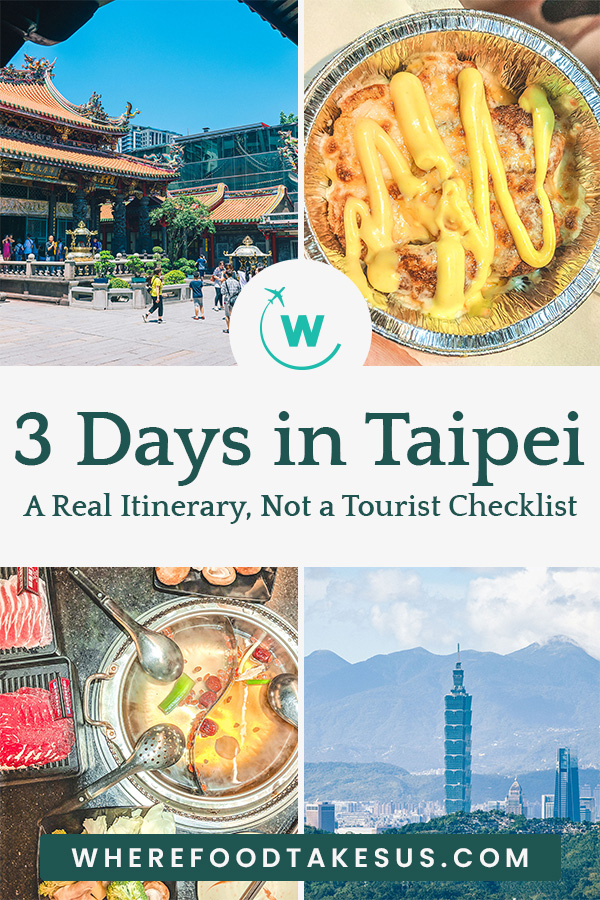
Our time in Taipei conjures up some wonderful memories (especially some delicious ones). While the food in Taipei was one of the best parts about visiting, there’s so much more to the “Heart of Asia” capital. Our itinerary for 3 days in Taipei will have you sampling the Taiwanese delights and seeing the main sights, but also take you to a few lesser-known places. We also mention some amazing day trips!

3 Days in Taipei Itinerary Overview and Tips
A few things worth knowing before you dive into the day-by-day plan.
Getting Around
Taipei is a huge city, and three days isn’t much time to get from sight to sight on foot. We always default to exploring on foot when we can, but for a trip this short you’ll want to lean on the MRT (Taipei’s metro).
A quick note since this itinerary was built from a visit a few years back: at the time there was a 3-day unlimited pass, but that doesn’t appear to be sold anymore. Taipei Metro currently offers a One-Day Pass (NT$150) and a 24-hour pass (NT$180), on top of the standard EasyCard you can just tap and go with. For three days, doing the math on individual EasyCard fares versus stacking a couple of 24-hour passes is worth it, since which one wins depends on how much ground you’re covering. Check Taipei Metro’s official fare page when you land, since this is exactly the kind of thing that keeps changing.
Do We Mention the Night Markets in This Itinerary?
Of course. We only put them on Day 3, though. You could easily hit a different night market every night of your trip, but we worked in some other food stops along the way for variety.
Just Three Days? Is That Enough?
Honestly, no. We spent enough time in Taipei to know there’s a lot more to the city than most travelers get to. But three days is enough to eat well, get a feel for the place, and still fit in a day trip
If Taipei is the only stop on your Taiwan trip, take at least one extra day to get outside the city. Taiwan outside its capital is worth it too.
When to visit
Don’t visit in summer if you can help it. Taipei is one of our favorite cities, but we won’t be going back during the hot months. We visited in August once and it wasn’t our brightest scheduling decision: it’s muggy, you’ll sweat through your clothes walking between sights, and typhoons are a real risk late in the season. November through April is a better bet, though honestly the food and the people are worth it whenever you go.
Day 1: Amazing Breakfast and Some Major Sights
Day 1 starts strong with food, then moves through some of the city’s biggest cultural landmarks.
Get Breakfast at a Soy Milk Restaurant
One thing we fell in love with in Taiwan was soy milk restaurants. These small establishments are scattered around Taipei but serve pretty similar fare: salty or sweet soy milk, sesame flatbread (shao bing) filled with egg, pork, or a stick of fried bread (you tiao), and xiao long bao. Everything’s cheap enough that you can order a handful of items and just try it all.
Our favorites are Yong He Soy Milk King in the Da’an District and Sihai Soy Milk in Datong District. We go into more detail on soy milk restaurants if you want the full rundown.

Longshan Temple
Originally built in 1738, this temple has been rebuilt or restored multiple times over the years after earthquakes, fires, and even a WWII bombing. It’s full of Buddhist elements along with altars and rooms dedicated to Chinese deities, all beautifully decorated and open to visitors (just be respectful while you’re there).
There’s a fountain across the street if you need to cool off in summer.

Taipei Botanical Garden
After lunch, it’s worth carving out time for Taipei Botanical Garden, right in the heart of the city. It’s been there since 1921, spread across 17 sections and nine ponds, home to over 100 plant species.
We could spend hours wandering around botanical gardens and this one was no different. The flora and fauna were wonderful to observe and learn about but our favorite part was taking in the lily pond and watching a local artist paint the scene.
Summer brings a proper lotus bloom across the ponds, and if you’re there in winter it’s the fall color instead. It’s free to enter (donations welcome), open early (5:30am) to late (10pm), though the greenhouse keeps shorter hours, roughly 9am to 4pm.


Chiang Kai-shek Memorial Hall
This large hall is dedicated to General Chiang Kai-shek, former leader of the Republic of China (not to be confused with the People’s Republic of China). The art exhibits on the ground floor are free, as is the walk up to the statue.
One thing that’s changed since we visited: the honor guard ceremony no longer happens in front of the statue itself.
As of a 2024 update, it now takes place on Democracy Boulevard in front of the Hall’s stairs, running hourly from 9am to 5pm (nine performances a day), each lasting about 15 minutes. It’s canceled if it’s raining.

Suho Paper Memorial Museum
A small, easy-to-miss museum in the Zhongshan district covering the art of hand papermaking across three floors. You can even try making a sheet yourself to take home. It’s closed on Sundays, so plan around that. Pricing when we visited was NT$100 for entrance or NT$180 with the paper-making activity included, but it’s worth confirming current pricing before you go.
We rarely hear other travelers mention this one. It’s a hidden gem.

Din Tai Fung for Dinner
This restaurant serves the best xiao long bao we’ve had, hands down. Beyond the soup dumplings (get those no matter what), they also do steamed and fried dumplings with pork, chicken, or crab, plus rice, noodles, soups, and steamed buns. It’s pricier than a lot of Taipei’s other food options, but it won’t break the bank. You can watch them roll the dumplings while you wait.

Day 2: The Best View of Taipei
Day 2 covers the most ground: a major museum, a couple of markets, and the hike this day is named for.
Breakfast at 7Eleven
Seriously? Breakfast at 7-Eleven? You bet!
7-Eleven (and its rival FamilyMart) is everywhere in Taipei, and you’ll struggle to walk ten minutes without passing one. Breakfast, lunch, snacks, toiletries, printers, postal services, they’ve got it all. For breakfast, grab a tea egg or two, a milk tea or juice, and one of their surprisingly solid sandwiches. Plenty of locals stop here while on the go.
National Palace Museum
A massive museum with one of the largest collections of imperial Chinese artwork and artifacts anywhere. We wore ourselves out before we got through everything, so read up ahead of time and go in with a plan rather than wandering.
We found the audio guides more overwhelming than helpful. The English plaques give you enough. There’s no MRT station right at the museum, so taxi is easiest, though public buses (R30 from Shilin Station, or B13/B20 off the Wenhu Line) will get you there too. Go right when it opens if you can. Tour groups tend to show up by late morning.

Jianguo Holiday Jade and Flower Markets (weekends only)
Two markets worth carving out time for, open Saturdays and Sundays from 9am to 6pm (some vendors pack up after lunch, so don’t leave it too late). The jade market runs to around 700 stalls of stones, jewelry, and antiques, haggling expected. Right across from it, the flower market is the bigger of the two, plants, bonsai, lucky bamboo, plus a scattering of ceramics, vintage finds, and even the odd Studio Ghibli figurine. Both markets sit under an overpass, so they’re a solid rainy-weekend option too. It’s a five-minute walk from Daan Park MRT (exit 6), and it’s worth knowing this is more of a locals’ market than a tourist one, so don’t expect much of any English.

Eat Gua Bao
Gua bao, the so-called Taiwanese hamburger, is a must. The best (the original) is at Lan Jia Gua Bao: a steamed bun cut open and filled with braised pork belly, ordered fatty, lean, or half and half, topped with pickled mustard greens, crushed peanuts, and cilantro. Pair it with sticky pork rice or corn soup, or both. Cheap and perfect for lunch.

Da’an Forest Park
We love to seek out green spaces in cities and Taipei is no different. What’s great about this metropolitan area is the abundance of parks available to reconnect with nature.
If you need to relax and digest, Da’an Forest Park is it. Wander the paths down to the pond, where you’ll usually spot some birdlife. There’s also a stretch of stone walking path meant for bare feet, a kind of foot massage. We tried it and you should too. It’s an experience you see many locals partaking in.
We’ve got a full rundown of parks in Taipei if you want more options beyond this one.


Hike Elephant Mountain
We call it a hike, but it’s really just a lot of stairs (and we mean a lot!) leading to arguably the best view of Taipei. You’ll feel it in your legs, but when an elderly man passes you running backwards down the steps, keep some perspective. There’s a crowd at the one rock everyone poses on in front of Taipei 101. If you have to have that photo, plan to wait. Head further back and you’ll find a patio with an even better view and way fewer people.
We’ve got a full guide to Elephant Mountain if you want more on timing it right (hint: go at night or super early).

Mala Hot Pot
There’s no shortage of hot pot in Taipei, but this was our favorite. You get two hours to eat as much as you want, with an all-you-can-eat ice cream station and all-you-can-drink Taiwan Beer and soft drinks thrown in. Pick a broth, pick your meat (or skip it), and load up on vegetables and seafood.
A caveat since it’s been a while: there are a couple of similarly-named hot pot chains in this part of town now, so double check the current location, hours, and payment options before you go rather than relying on the address we had.

Day 3: Tea, Taipei 101 and Night Markets!
Day 3 slows down a bit, starting up in the hills before coming back down for the city’s most iconic building and a proper night market to close things out.
Taipei Zoo
Even if you’re not traveling with kids, Taipei’s zoo is worth the visit. It’s one of the ten largest municipal zoos in the world, and the largest in Southeast Asia, home to more than 400 species across its indoor and outdoor areas. We beelined for the pandas first (past the food area near the entrance), and they were asleep, but they were the first pandas we’d ever seen. Beyond the pandas, the Formosan Animal Area is worth seeking out for species you won’t find outside Taiwan, sika deer and Swinhoe’s pheasants among them.
The elephant exhibit was another highlight for us. The enclosure is designed so you can get right up close, and we spent a good while watching them cool off in the water. It felt a lot more intimate than a typical zoo setup.
General admission is NT$100 (NT$60 for Taipei residents, NT$50 at the discount rate).


Maokong Gondola to Tea Mountain
The zoo connects directly to the gondola. You can catch it inside the zoo at Taipei Zoo South Station, but we’d leave the zoo and catch it at Taipei Zoo Station instead, just up the street from the zoo entrance. One-way tickets run NT$180, or there’s a One-Day Pass for NT$300 if you want to ride it more than once.
The ride up takes 20 to 30 minutes and passes over some gorgeous temples and views of Taipei on the way. Maokong itself has dozens of traditional teahouses scattered across the mountainside, plus actual tea plantations you can walk through, a handful of hiking trails (some lead to waterfalls and city viewpoints), and the multi-building Zhinan Temple complex if you want to turn this into a full afternoon rather than just a lunch stop like we did.

Lunch With a View
Once you’re up top, find a tea house and try as many flavors as you want. We sat down at Maolan Tea, more touristy than some options, but the view drew us in.
After lunch, walk over to Ice Climber, also on Maokong, for shaved ice or ice cream. We went with vanilla topped with chocolate sauce and sliced bananas, and it hit the spot after all that tea.
We’ve got a whole post on our day at the zoo and Maokong if you want more detail.


Taipei 101
It’s no longer the tallest in the world, but that doesn’t mean you should skip the city’s most iconic building. General admission (89F and 88F) runs NT$600, with an extra NT$380 if you want to go all the way up to the 101st floor outdoor deck. The observatory is open daily, 10am to 9pm. Ride the speedy elevator up for a 360-degree view, ideally around sunset. Don’t skip the steel wind damper on your way through. It’s built to withstand the earthquakes and typhoons that are a regular part of life here.

Taipei Night Markets
No trip to Taipei is complete without a night market, and the city has more of them than you could hit in a week, let alone one night.
We stayed in an Airbnb out in Banqiao (technically New Taipei City, think of it as Taipei’s sprawling suburb) and ended up finding our favorite night market completely by accident: Banqiao Nanya. It’s less touristy, mostly locals, and has some of the best fried shrimp and cheese on a stick, as well as all the other night market classics.
For the rest of Taipei’s big-name markets, Ningxia, Shilin, and Raohe among them, we go deep on all of them in our Taipei night markets guide.


More Time in Taipei?
Below we list a few of our favorite day trips from Taipei. They are easily accessible and contain links to posts that further explain how to get there and what to do!
Taroko National Park
Ideally you’d stay a few nights in Hualien to properly explore Taroko, but it’s doable as a day trip from Taipei too. One real update since we went: the April 2024 earthquake caused major damage here, and while the gorge has reopened, it’s running on a limited timed schedule for driving through, and most of the well-known hiking trails, Shakadang and Swallow’s Grotto among them, are still closed and expected to take years to fully recover. What’s currently accessible is more limited: the visitor’s center, a couple of shorter trails, and the upper gorge area. Worth checking current status before building a day trip around it, since it’s a different experience than it was a few years back.
We go into visiting Taroko National Park as a day trip in more detail, including how to get there.

Keelung
A quick, cheap train ride gets you to Keelung and its gorgeous northeast coast, including memorable spots like Shen’ao’s Elephant Trunk Rock. The city’s Miaokou Night Market is the main draw for food, labeled in English as well as Mandarin and Japanese, so it’s easy to navigate even if you don’t hit any of our recommendations in the Keelung guide. If you have extra time, Zhongzheng Park’s hillside Guanyin statue (you can actually climb inside it) gives you a good harbor view, and Heping Island Geopark has coastal walks and a seawater pool if the weather’s cooperating. Full details in our Keelung day trip guide.

Yangmingshan National Park
If you’re into the outdoors, Taipei has you covered. Yangmingshan National Park is practically next door, with day hikes under an hour away by public transport. Beyond the hike up Mt. Qixing, the park has a free hot spring at Lengshuikeng (traditional bathhouse plus a foot-soaking pool, open 8:30am to 4:30pm), volcanic features you can actually watch happening at Xiaoyoukeng (steam vents, bubbling ground), and if your timing lines up, calla lilies bloom at Zhuzihu from mid-March through mid-April. Check out the views of Mt. Qixing, or swing by the visitor center for hiking tips.

Frequently Asked Questions
Not really, but it’s enough to eat well, see the major sights, and fit in one day trip. If Taipei is the only place you’re visiting in Taiwan, we’d add at least one more day to get outside the city.
November through April. Summer in Taipei is muggy, and typhoons are a real risk later in the season. We learned that one the hard way visiting in August.
The MRT covers most of the city and is easy to use. For a 3-day trip, weigh individual EasyCard fares against Taipei Metro’s One-Day (NT$150) or 24-hour (NT$180) passes, since which one’s cheaper depends on how much ground you’re covering.
It’s reopened, but on a limited timed schedule for driving through, and most of the well-known trails are still closed for repair. It’s still worth seeing, just a scaled-back version of what it used to be. Worth checking current status before you build a day around it.
Summary of 3 Days in Taipei Itinerary
Three days in Taipei isn’t nearly enough, but it’s a great place to start. By the end you’ll have eaten your way through some of the best food in Asia, taken in some incredible views and experienced some of the friendliest people in the world. Happy travels!