What’s the best way to see New Zealand? By car, hands down. How else would you find that gravel road leading to a lush paddock between awe-inspiring peaks? The best of New Zealand lives outside its cities and towns, and a car is the only way in. Driving in New Zealand is a little different than what most of us are used to, and we want to walk you through what to expect before you get behind the wheel to explore this otherworldly country.
We logged more than 2,000 miles on our trip across 13 nights. You can read more on the entire trip in our New Zealand Itinerary. We drove a few different types of rental cars in different terrain, accidentally put petrol in a diesel truck (more on that shame later), and crossed enough one-lane bridges, gravel roads and water crossings to have opinions.
If you haven’t worked out your route yet, check out our New Zealand planning guide first. This post is just about driving itself.
Renting a Car in New Zealand
Before you book anything, there are a few things worth sorting out: your license requirements, which vehicle actually makes sense for this trip, and whether you need extra insurance.
Do You Need an International Driving Permit?
This is the first thing everyone worries about and it’s almost always a non-issue. If your license is in English, you can drive in New Zealand on it alone for up to 18 months from your entry date with a standard car license. It’s 12 months for things like motorcycle or commercial truck licenses. No International Driving Permit (IDP) required.
If your license isn’t in English, you’ll need either an IDP or a certified translation alongside the original and you’ll still have 18 months from your entry date. Either way, have your physical license from your home country on you any time you’re driving. A photo on your phone won’t satisfy a roadside check.
Choosing the Right Vehicle


We rented three different vehicles for this trip: a RAV4 for the Nelson and Golden Bay stretch, and a diesel Ford Ranger truck for the longer South Island leg down to Queenstown, and a Toyota Vitz (didn’t know what that was) for our couple days on the North Island. The truck was capable and comfortable, but it was more than we needed. In hindsight, we’re glad we got the truck because our other option was a sedan and it would not have done well.
If we did it again, we’d go with a hybrid AWD SUV for the whole trip. You get the all-wheel drive for gravel roads and farm access (several LOTR filming locations and remote viewpoints require it), the fuel efficiency to soften the blow of New Zealand’s gas prices, enough clearance for shallow water crossings and a size that’s manageable on narrow mountain roads.
A few things worth knowing before you book:
- AWD is genuinely useful, not just a nice-to-have. Plenty of worthwhile stops, like Mount Sunday, sit at the end of long, gravel roads.
- Smaller is better on most New Zealand roads. Mountain passes narrow quickly, parking in small towns is tight, and you’ll be on single-lane roads more often than you’d expect.
- Automatic transmissions are the norm. While much of the world still drives manual, New Zealand, like the U.S., has adopted automatic transmissions. This means you won’t be paying a premium for your rental. If you’re set on driving a manual, they may be a bit harder to come by.
- Hybrid if you can get it. Fuel is almost double US prices, and New Zealand is a country worth driving. So save on fuel costs if you can by renting a hybrid. For now, charging stations aren’t as common, so a self-charging hybrid vs a plug-in hybrid or full electric would be better. That said, the New Zealand government has plans to increase its charging stations to 10,000 by 2030. That’s a bit of a stretch goal but it’s obvious they’re working to add more.
Rental Car Insurance
New Zealand rental companies will try to sell you their own collision/damage waiver, and it’s rarely the best option for travelers. A few other options worth knowing about before you’re standing at the counter:
- Some credit cards include rental coverage as a cardholder benefit, but check the fine print. New Zealand specifically, and gravel/4WD exclusions, are common gaps.
- Standalone travel insurance with a collision damage add-on (companies like SevenCorners or Allianz offer this) is often cheaper than the rental counter’s own waiver and gives you more coverage.
- Some personal car insurance policies extend to rentals. Always check your policy well in advance to verify.
- If you do plan to drive on gravel or unsealed roads, double-check that your policy and rental agreement actually allow it. Some rental contracts exclude damage on unsealed roads entirely, which would have mattered to us more than once on this trip.
Fuel and Gas Stations
Fuel is pretty straightforward in New Zealand but learn from our mistakes!
Know Your Fuel Type
It’s embarrassing but we have to confess this one. On our last full day near Lake Tekapo, we put petrol in our diesel truck. The green handle was regular and the black handle was diesel, which is the reverse of what we’re used to in the US. Not that we ever use diesel in the US, but we obviously just weren’t paying attention. By the time we noticed, the damage was done.
We’d planned to hike the Tasman Glacier View Track that afternoon. Instead we lost half the day arranging a fix. If this happens to you: do not start the engine. The damage gets dramatically worse the moment you turn the key. We couldn’t reach our rental company by phone, so we called a local mechanic about 30 minutes away who came out, drained the tank, and got us back on the road. Once we cleared the air from the lines, the truck was fine.
Know your fuel type before you ever leave the rental lot, and double check it every single time you fill up. Diesel pumps are sometimes a different color, sometimes a different nozzle size, and it is very easy to be on autopilot at a pump in a country you don’t live in.
For any kind of car trouble while driving around New Zealand, keep in mind the further you are from a major city like Christchurch, Auckland, or Queenstown, the harder it may be to find a mechanic should you run into car trouble, especially on the weekends.

Gas Stations Are Sparser Than You’d Think
Coming from the US, you get used to gas stations appearing constantly. They don’t in New Zealand, especially on the South Island, where you can go an hour or more between stations. Fill up at half a tank rather than waiting for the light to come on.
Some pumps, especially the unmanned ones you’ll see on Google Maps, have no shop, no bathroom, and no snacks attached. If you’re relying on a gas stop for food or water, plan ahead instead.
The Rules of the Road
This is where New Zealand driving genuinely differs from what most visitors are used to, more so than the UK or Australia in a few specific ways. We’d recommend reading through the NZTA’s official driving guide for the full rundown, but here’s what actually came up for us.
Drive on the Left
The expected one. Give yourself a day to adjust, and take it slow getting out of parking spots. We bumped the curb a few times, much like when we first drove in the UK. It takes some getting used to!
Give-Way Rules Are Genuinely Different
This is the one that trips up the most visitors, including us at first. New Zealand’s give-way rules at uncontrolled intersections aren’t the same as the US, UK, or Australia:
- If you’re turning, you give way to all traffic that isn’t turning.
- If you’re turning right and an oncoming car is turning left or going straight through, you give way to them.
- At an uncontrolled T-intersection, traffic on the terminating road (the “bottom” of the T) gives way to all traffic on the continuing road (the “top” of the T) — this applies even if nobody’s turning, so it catches people off guard at rural junctions and driveways.
- Roundabouts run clockwise, and you give way to traffic already in the roundabout, meaning traffic coming from your right.
New Zealand updated its give-way rules in 2012 and just to be on the safe side, we recommend checking out those give-way changes before you go.
One-Lane Bridges and Passing Bays
These are everywhere on the South Island. There are two signs you should watch out for when approaching a one-lane bridge:
Give Way: You must allow oncoming traffic priority when you see the red circle signs with the small, red arrow on the left and the large black arrow on the right. This signifies oncoming traffic has the right of way.
Right of Way: when you approach a single-lane bridge and see a blue sign with a large white arrow pointing in your direction and a small red arrow pointing in oncoming traffic’s direction, you have the right of way and oncoming traffic should give way to you.

One lane bridge ahead

You have the right of way

You give way to oncoming traffic
Slow down regardless, and actually look for oncoming traffic before committing. Some bridges are long enough that you can’t see the far end, in which case there are usually marked passing bays so you can wait safely rather than meeting another car in the middle.

Speed Limits and Cameras
The open road limit is 100 km/h, dropping to 50 km/h through towns and built-up areas, and as low as 30 km/h through active roadworks. Limits can vary by road and are well signed, so when in doubt, look for the sign rather than assume. Speed cameras exist but are far less of a culture than the UK’s; police presence on the open road is more common here than the camera network. Either way, fines apply to visitors the same as locals and will be charged to the card on file with your rental company if you’re caught.
Drink-Driving Limits
If you’re 20 or older, the legal limit is roughly equivalent to 0.05% BAC, lower than the US’s 0.08%. If you’re under 20, the limit is zero. If you’re doing an afternoon of wine tasting in Central Otago or Marlborough, plan for a sober driver or book a tour instead. Or you can bike to a couple wineries like we did but it was more workout than wine!
Toll Roads
New Zealand has a small handful of toll roads, none of which have physical tollbooths. They’re clearly signed with the toll amount and a free detour option if you’d rather avoid it; tolls are typically paid online within a few days of driving the road. During our 2 weeks on the north and south islands, we never once encountered a toll road.
Things to Pay Attention To
None of this is dangerous, but a few quirks are worth knowing about before you’re out there.
Distances Are Deceptive
A 200km (124 miles) drive sounds short until you’re a few hours into it. Mountain passes, single-lane sections, sheep crossings, and views you genuinely can’t resist stopping for all add up fast, especially on the South Island. Build buffer time into every driving day, more generously than your GPS estimate suggests.
The North Island’s driving was more straightforward in our experience yet still quite hilly and narrow. The South Island is where the switchbacks, gravel sections, and slow, scenic roads really come into play.
Sheep, Stock, and Slowing Down
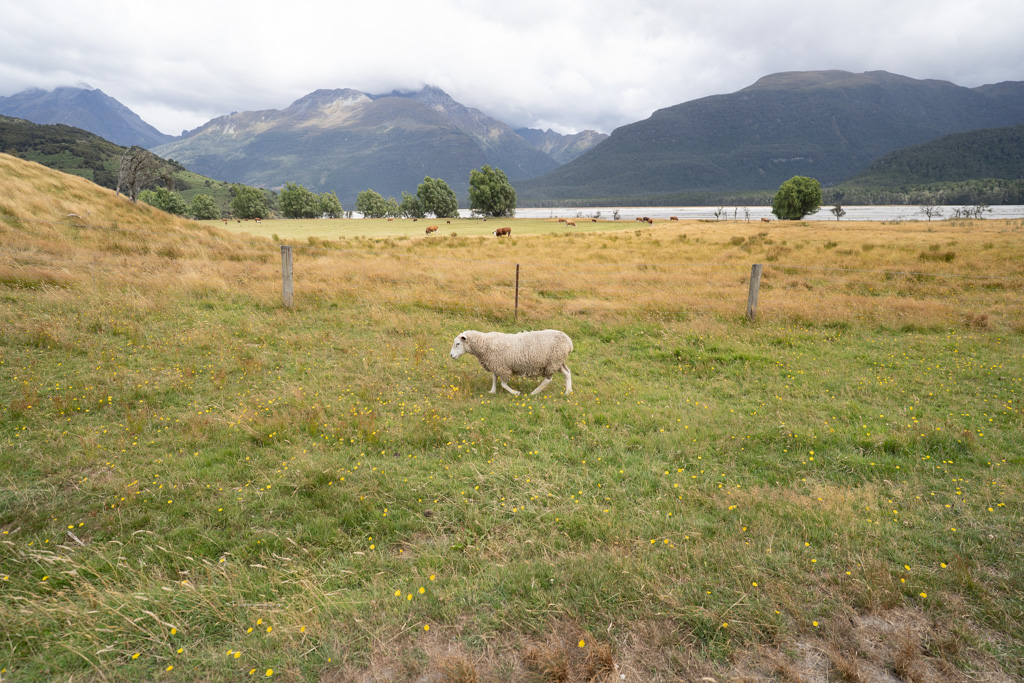
Sheep often wandered onto back roads while we were exploring. Some cows held us up too, especially near Mount Sunday. Slow down through farmland, keep your eyes up rather than on your phone, and expect the occasional full stop while the animals pass. This is a great time to get out and snap that photo (at a distance!).

Hitchhiking Is More Normal Here
We picked up a couple of hitchhikers on the South Island, mostly people heading to or from trailheads, and they were great company for a few miles. Hitchhiking carries a different, more casual reputation in New Zealand than in most countries we’ve driven in. Use your judgment, but if you’ve got room, it’s a nice thing to do. You’ll find a lot of hitchhikers are traversing both islands over several months and are extremely grateful for the chance to rest their feet. Needless to say, we were jealous of their treks!
FAQ: New Zealand Driving Rules
Not if your license is in English. You can drive on a valid overseas license for up to 12-18 months depending on license type. If your license isn’t in English, you’ll need an IDP or certified translation alongside it.
At intersections without signals, turning traffic gives way to non-turning traffic, and to oncoming traffic also turning across your path. At roundabouts, traffic already in the roundabout (coming from your right) has priority.
Look for the sign before the bridge. A long arrow pointing toward you means you give way while a short arrow means you have priority. Slow down either way and check for oncoming traffic, especially on bridges where you can’t see the far end.
250 micrograms of alcohol per liter of breath for drivers 20 and over, which is stricter than the US limit. Zero tolerance for drivers under 20.
Yes, though enforcement leans more heavily on police presence than fixed cameras compared to somewhere like the UK. Fines apply to visitors and are billed through your rental company.
A few, all without physical tollbooths. They’re well signed with toll amounts and usually a free alternate route.
Final Thoughts
None of this is meant to scare you off. New Zealand’s roads are some of the most rewarding we’ve driven, switchbacks, one-lane bridges, and bumpy roads included. Know the rules before you go, build buffer time into your days, and you’ll be fine. Drive carefully, and happy travels!