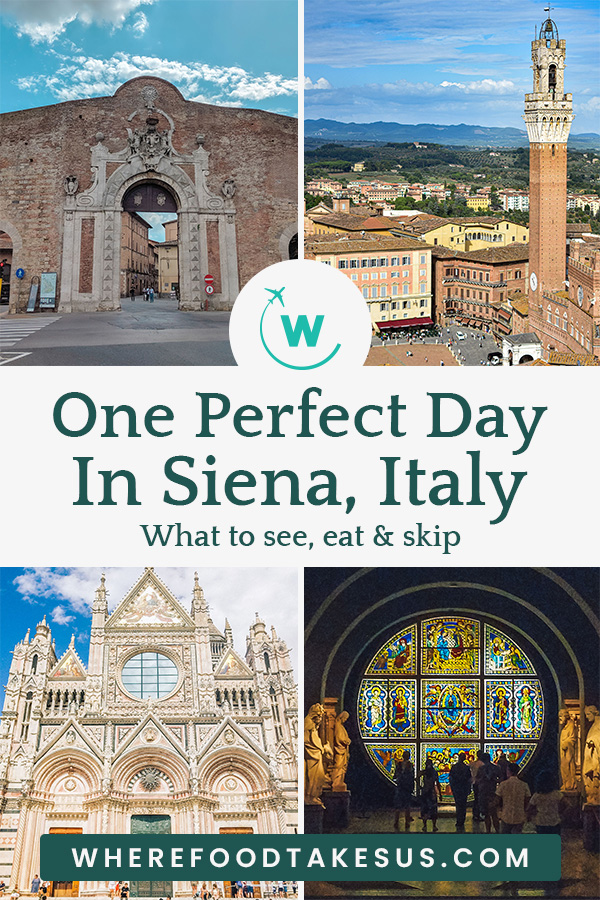
Siena is one of our favorite towns in Tuscany, and one day is genuinely enough to see it well. We arrived by train mid-morning and left after dinner, and in that time we made it through the entire Duomo complex, climbed the Facciatone for the best view in the city, found a church that almost nobody visits, and ate one of the best (and most affordable) meals of our trip.
This post walks through that day in the order we did it: what we saw, what we’d do differently, what we rushed and shouldn’t have, and where to eat that isn’t the Piazza del Campo. It’s a real account of one day in Siena, with enough practical detail to follow the same route if you want to.
As we mentioned in our guide to San Gimignano, plenty of people try to squeeze both towns into a single day. It’s doable, but we’d rather give each one the time it deserves.

Our Day in Siena at a Glance
Here’s how we spent our day, grouped by area.
Piazza del Campo: The heart of the city and the natural place to start. Coffee, gelato, and the first good look at the tower.
The Duomo Complex: The bulk of the day. The cathedral itself, plus the Piccolomini Library, the Baptistery, the Crypt, the Museo dell’Opera, and the climb up the Facciatone for the best view in Siena. One ticket covers all of it.
Beyond the Duomo: Basilica Cateriniana San Domenico, the Medici Fortress, and the Basilica of San Francesco, which almost nobody visits and turned out to be one of our favorite stops.
Dinner and the Old Town: Dinner away from the piazza at Tigella Emilia, then wandering the side streets as the lights came on.
We arrived mid-morning by train and left after dinner, and that was enough time to do all of it without feeling rushed. If you get an earlier start than we did, do the Facciatone first. It’s the only stop with a real queue and we waited close to an hour in September.
Is One Day Enough in Siena?
Yes, with one caveat: one day is enough to see Siena, not to linger in it.
The city is compact and almost everything worth seeing sits within the old town walls, so you’re never far from your next stop. We covered the Duomo complex, three churches, a fortress, and a long dinner without once feeling like we were racing the clock.
What you don’t get is much slack. Siena is dense with art, and the Duomo alone could absorb half a day if you let it. If you want to sit in the Piazza del Campo for a couple hours doing nothing, or take a proper look at everything inside the Museo dell’Opera, you’ll want a second day. The good news is that the OPA SI Pass is valid for three consecutive days, so spreading it out costs you nothing extra.
If you only have half a day, focus on the Piazza del Campo and the Duomo and accept that you’re skipping the rest. We wouldn’t recommend it, but it’s better than not seeing Siena at all.
How to Get to Siena
Unlike San Gimignano, Siena is easy to reach on your own. Most people come from Florence, but it also works as a day trip from other Tuscan towns and, if you don’t mind a lot of time in transit, from Rome or Pisa. Just know that Siena rewards an unhurried day, so the further you’re traveling, the harder we’d think about whether a day trip is worth it.

By Train
Trenitalia runs to Siena from Florence and other Tuscan hubs, and the ticket machines at every station are straightforward to use. We came in from Poggibonsi, which served as our Tuscan base, on a roughly 45-minute train ride. There are plenty of departures daily. Check ItaliaRail for schedules and tickets. The one catch: the train leaves you at the bottom of the hill, so factor in the climb up (more on that below).
By Bus
Coming from Florence, the bus has one advantage over the train: we read that it drops you closer to the historic center and saves you the climb up the hill entirely. If you’re starting your day in Florence, it may be the easier option.
Getting Up the Hill
If you arrive by train, you’ll be at the bottom of the hill with the old town above you. You can catch a local bus, but it costs extra, so we chose to walk. Head through the Porta Siena mall across from the station and take the escalators, which do most of the climbing for you. There are quite a few of them, but once you reach the top it’s only a five to seven minute walk to the old town gate.
When to Visit Siena
Shoulder season is ideal here, like most places. We visited in early September, just after the summer crowds had thinned out. Being Tuscany, there were still plenty of people around, but nothing like peak season.
We enjoyed warm days and cool nights. If you want good weather with fewer crowds, autumn and spring are the sweet spots. We had room to spread out in the piazza and even the Duomo wasn’t too overwhelming.
If you want to be there for the Palio, the famous horse race held in the Piazza del Campo, you’ll need to time your visit around July 2 or August 16. Be ready for a serious crowd, but this is the case where the crowds are the point rather than a problem.

Tickets and the OPA SI Pass
Siena packs a lot of art into a small area, and with one day you have to be a little picky. The good news is that the main sights are bundled into a single ticket, so you’re not buying admission one sight at a time.
The OPA SI Pass costs 14 euros per person, or 16 euros during the periods when the Duomo’s marble floor is uncovered. Children aged 7 to 11 pay 3 euros and under 7s go free. Check prices and other information before you go by visiting the official Opera della Metropolitana site. The pass covers:
- The Duomo
- The Piccolomini Library
- The Baptistery of San Giovanni
- The Crypt
- The Museo dell’Opera
- The Panorama from the Unfinished Facade, better known as the Facciatone
- The Gate of Heaven
- The Oratory of St. Bernardino
The pass is valid for three consecutive days, so if you’re staying longer there’s no need to cram it into a single visit.
One change worth knowing about if you’ve read older guides, including our own original version of this post: the ticket now advertises a free audioguide delivered to your smartphone. We haven’t used it ourselves, so we can’t tell you how good it is or exactly what it covers, but it’s included at no extra cost and worth asking about at the ticket office.
You can buy the pass online or in person. There are two ticket offices: one at Piazza Duomo 7, right by the cathedral, and one at the “Dear Guests” Visitor Center on Via di Citta 48, near the Piazza del Campo. If you’re starting your day in the piazza like we did, the Via di Citta office is the more convenient of the two.
About the Duomo Floor
The Duomo’s marble floor is one of the most remarkable things in the building, and for most of the year large sections of it are covered to protect them. It’s fully uncovered for a limited window each year, and that’s also when the pass costs the extra two euros. Check out Opera della Metropolitana before you go as the dates shift from year to year. At the time of writing they run from late June to the end of July, and again from mid-August through mid-November.
What We Did
Here’s everything we did over our day in Siena, roughly in the order we did it. We started where everyone should, in the heart of the city.
Piazza del Campo
The most iconic spot in Siena and the right place to begin. We came back here more than once during our day and enjoyed it every time. Grab a gelato from one of the shops just off the square and eat it while you cross this enormous space. It’s also a fine place to sit down for an espresso, though you’ll pay a small premium for the address.

The Duomo Complex
Most of your day happens here. The cathedral and everything attached to it sit within a couple of minutes’ walk of each other, and one ticket covers the lot.

Siena Duomo
The other unmissable sight in the city, and it lives up to every bit of its reputation. This Gothic cathedral is worth real time rather than a quick loop. When we visited, audio guides were sold separately inside and we skipped them.
The explanatory signs scattered around the cathedral were well done and we didn’t feel we’d missed anything. Since then the ticket has started advertising a free smartphone audioguide, so it’s worth asking at the ticket office, though we can’t vouch for it ourselves.
Either way, give this place more time than you think you need.
Look down as well as up. The floor is every bit as interesting as the ceiling, and every surface in the building is doing something. Don’t miss Donatello’s sculpture of St. John the Baptist while you’re in there.

Piccolomini Library
Off to the side of the Duomo. It’s a little confusing because the ticket office presents it like a separate exhibit, when it’s really just another room inside the cathedral. Walk in and look up. It’s one of the most striking spaces in Siena.

Baptistery of San Giovanni
Still the Duomo, except this time you exit and walk around to the back. More frescoes, packed into a surprisingly small space. By this point you’ll have stopped being surprised by how much art Siena fits into a single block. After the Baptistery, the Crypt is a couple of steps further and worth ducking into for more frescoes, some of the oldest in the whole complex.

Museo dell’Opera
You’ll also see the building signposted under the Opera della Metropolitana, the organization that runs the whole complex, which is confusing the first time you come across it. We weren’t expecting much from this museum. We were in a hurry to reach the Facciatone for the views, and you have to pass through the museum to get there.
We were wrong to rush it. There are beautiful sculptures by Pisano, another Donatello, paintings from the 12th and 13th centuries, and the original stained glass rose window that once sat in the Duomo.

Facciatone
When people talk about the best views in Siena, they usually mean the Torre del Mangia in the Piazza del Campo. We’d point you here instead. From the Facciatone you get the Duomo, the rooftops, the Torre del Mangia, and the Tuscan countryside all at once.
The catch is the line. This is the only stop of the day with a real wait, and ours ran about 45 minutes to an hour in September. We imagine July gets pretty intense.
It’s worth it though. They send you up in groups of roughly 20 to 30 people and give you enough time at the top to actually enjoy it rather than shuffling you straight back down. We had around ten minutes up there, which was plenty for photos and, more importantly, enjoying it all in the moment.
Tip: If you arrive in Siena early, make the Museo dell’Opera and the Facciatone your first stops of the day.

Beyond the Duomo
Once you’re done with the Duomo, the rest of Siena opens up. These next few stops are more spread out and involve a bit more walking, but they’re quieter, mostly free, and the routes between them serve up some of the best views in the city.
Basilica Cateriniana San Domenico
Another of Siena’s significant churches, and the resting place of the head of St. Catherine, along with more frescoes worth your time. It’s an easy walk from the center, and the route there gives you some of the best views back toward the tower and the Duomo. We got a rainbow on our walk over, which we’re still smug about.

Medici Fortress
It wouldn’t be a Tuscan town without a Medici fortress. Siena’s is impressive, and the top of it gives you space to spread out, good light in the evening, and what looked like a decent local events scene. It had the feel of somewhere locals go, rather than just another tourist stop.

Basilica of San Francesco
We hadn’t read a thing about this church. We only went because we spotted it on Google Maps and had a short window to fill before dinner. It turned out to be one of our favorite stops of the whole day.
Almost nobody was there, it was free, and the high Gothic ceilings and the quiet made it feel completely different from the Duomo. Afternoon showers rolled in while we were there and we ended up sitting in the courtyard listening to the rain. That half hour is one of the things we remember most about Siena.


Wander the Old Town
More churches, shop windows, side streets, and no particular destination. We’d recommend walking until your legs give out. Siena’s back streets are the part of the city you’ll remember, and some of our best memories of the day are just wandering and looking around. It’s free, and it’s better with gelato in hand.
If you’d rather have some structure and a bit of history along the way, Rick Steves’ free Siena City Walk is worth downloading before you go. You can get it through his Audio Europe app or as a plain mp3 with a PDF map, and it costs nothing either way.

What We Ate
Here’s everything we ate over our day in Siena. Fair warning: for a food blog in a Tuscan town, remarkably little of it was actually Tuscan.
Lunch: Ravioli Wang
We’ll be honest about how our day in Siena actually started, which was with Chinese food.
We’d been on the road for several months at that point, and after a long stretch of Italian food we wanted something else. Ravioli Wang sits just outside the old town walls on Viale Vittorio Emanuele II, which puts it more or less directly on the route up from the train station. We had steamed dumplings and an order of potstickers. Now that we’re writing this post, however, we’re craving some Tigelle with prosciutto and might wish a little differently.
We’re not going to pretend this is a Siena recommendation in the traditional sense. But if you’ve been traveling a while and the thought of another plate of pasta makes you tired, it’s there, it’s affordable, and we’d recommend it.

Dinner: Tigella Emilia
Walking back into the center from the Basilica of San Francesco, we found Tigella Emilia on Via dei Rossi and it turned out to be one of our favorites in Tuscany.
It’s run by a husband and wife, the pasta is made in house, and it costs a fraction of what you’d pay on the piazza. Worth knowing: the food here is Emilian rather than Tuscan.
Here’s what we had:
- Tigelle with prosciutto and stracchino. Tigelle are small, round Emilian flatbreads, split and filled at the table. Warm bread, salty ham, soft creamy cheese. Start here.
- Spinach tortelloni. Handmade, in the old Modena style. This was the standout.
- Mushroom pizza. It was a special the night we visited and it doesn’t seem to be on the regular menu, so we can’t point you to it by name. If they’re running something similar when you go, you won’t be disappointed.
Order the tigelle no matter what else you get. It’s the thing the place is named after and the thing we still talk about.
It’s a small operation, so check their current hours before you plan your meal.


Gelato
We had gelato more than once when wandering around Siena and so should you. The area immediately around the piazza has several options and you’re unlikely to go wrong.
What Food Siena Is Known For
We’ll be upfront here: we ate Chinese food and an excellent Emilian dinner. Neither was Sienese. So the list below isn’t us telling you what we ate. It’s what Siena is known for, in case you’re planning your eating better than we planned ours.
Pici: Thick, hand-rolled pasta from the Siena area, usually served with garlic and tomato, with breadcrumbs, or with a meat ragu. It’s the local pasta shape and the one to order if you see it.
Panforte: A dense, chewy cake of dried fruit, nuts and spices that has been made in Siena for centuries. It’s rich enough that a small piece goes a long way, and it’s sold in every food shop in the old town.
Ricciarelli: Soft almond cookies, chewy in the middle, dusted with powdered sugar. Easier eating than panforte and easier to bring home.
Cavallucci: Spiced cookies with walnuts and candied peel. Firmer and more austere than ricciarelli, and very much an acquired taste.
If you’re in Siena and you try any of these, we’d love to hear about it in the comments. It’s the part of our day we’d do differently.
Quick Tips for Visiting Siena
- Do the Facciatone first if you arrive early. It’s the only sight with a real line and the wait was close to an hour in September.
- If coming by rail, walk up from the train station rather than paying for the bus. The escalators through the Porta Siena mall do most of the work.
- Buy the OPA SI Pass rather than individual tickets. At 14 euros it covers the whole Duomo complex and it’s valid for three consecutive days.
- Don’t rush the Museo dell’Opera. We did, and we regret it.
- Skip dinner on the Piazza del Campo. Walk ten minutes in any direction and eat better for less.
- Visit in spring or autumn. Better weather, thinner crowds, and a far more pleasant wait for the Facciatone.
- The Basilica of San Francesco is free and nearly empty. Build it in.
What We’d Do Differently
Not a lot, honestly. One day in Siena worked out close to perfectly for us. But a few things stand out.
1. Slow down in the Museo dell’Opera.
We treated it as the corridor you walk through to reach the Facciatone, which is exactly the wrong way to think about it. There’s a Donatello in there, sculptures by Pisano, and the Duomo’s original rose window. We gave it maybe fifteen minutes of real attention. It deserved more.
2. Get to the Facciatone earlier.
We hit it mid-afternoon and paid for it with the better part of an hour in a hot, stuffy waiting area. Every one of the other stops on this list is walk-in. If we did the day again, we’d go straight there.
3. Leave room for a proper Sienese meal
We ate well across our day here, but none of it was Sienese. One day is enough to see Siena, but it’s tight, and a long lunch of local food is the thing that we lost out on. We’re honestly not sure what we’d drop to make room, everything we did felt worth doing, and that’s kind of the point we’re trying to make: one day is doable, but you feel the squeeze. If we came back, we’d find the time for a plate of pici and figure out the rest.
FAQ
Yes. Siena’s historic center is compact and you can comfortably see the Duomo complex, a few churches, the Medici Fortress, and still have a nice dinner. You won’t have much slack for lingering but it’s still a memorable and enjoyable day.
It’s one of our favorite towns in Tuscany. The Piazza del Campo and the Duomo alone justify the trip, and the back streets are full of charm.
Easily, and it’s the most common way people do it. Take the public bus or the train, depending on your preference.
Technically, yes. But we feel that’s a major disservice to either. Both towns reward an unhurried visit, and doing both in a day means rushing at some point. If you only have one day for the two of them, pick one. We cover San Gimignano in its own guide.
For a one-day visit, yes. It covers the Duomo, Piccolomini Library, Baptistery, Crypt, Museo dell’Opera, the Gate of Heaven, the Oratory of St. Bernardino, and the Facciatone, and they advertise a free audioguide on your phone with ticket purchase. Buying those separately makes no sense if you plan to see multiple sites.
You can buy on the day at either ticket office. There’s usually a line but it moves fast. Booking ahead on the official site saves you that step, which we’d recommend in any season.
The Torre del Mangia gets most of the attention, but we’d send you up the Facciatone instead. You get the Duomo, the rooftops, the tower, and the countryside in one go. Expect a wait.
Pici, a thick hand-rolled pasta from the area, plus a trio of local sweets: panforte, a dense spiced fruit and nut cake, ricciarelli, soft almond cookies, and cavallucci, firmer spiced cookies with walnuts. We didn’t get to try them ourselves, so consider this the research we wish we’d done before our visit.
July 2 and August 16, in the Piazza del Campo. Expect crazy crowds if you’re visiting for it.
Final Thoughts
One day in Siena is enough, and we’d argue it’s the minimum. There’s so much art packed into this city that trying to do it in an afternoon means skimming past things that deserve a proper look. Give it a full day and you get the Duomo without stressing, arguably the best view in Tuscany, a quiet church almost nobody visits, and a dinner you’ll talk about later.
If we had to sum up the day: stroll the piazza, don’t rush the museum, and leave time to get lost in the side streets.
Looking for more in this part of Italy? We also loved our organic wine and olive oil tasting on a family-owned estate in Chianti.
Been to Siena, or planning a trip? Drop a question in the comments.
Happy travels!